

The tradition of Sunday lunch in Emilia-Romagna
In Emilia-Romagna, Sundays have a distinct scent: that of ragù simmering gently, of fresh, hand-rolled pasta, and of stock prepared with care from early in the morning. Sunday lunch is not just a meal, but a family ritual that spans generations.
In the Food Valley, where food is part of the cultural identity, the Sunday meal is one of the most authentic moments of daily life.
A ritual that starts early: cooking in the morning
A Sunday in Emilia starts early. In traditional homes, preparing lunch is a communal effort: someone rolls out the pasta dough, someone else prepares the filling, and yet another keeps an eye on the sauce.
The sound of the rolling pin on the wooden table is almost symbolic. Making fresh pasta at home – tortellini, cappelletti, tagliatelle – is still today an act that brings together tradition and family.
It is not just about cooking; it is about passing on knowledge.
First courses: the heart of Sunday lunch
In Emilia-Romagna, the first dish takes centre stage.
Tortellini and cappelletti
Between Bologna and Modena, tortellini in broth reign supreme, whilst in Romagna, cappelletti are more commonly found. The broth is prepared using selected meats and slow-cooked.
Tagliatelle with ragù
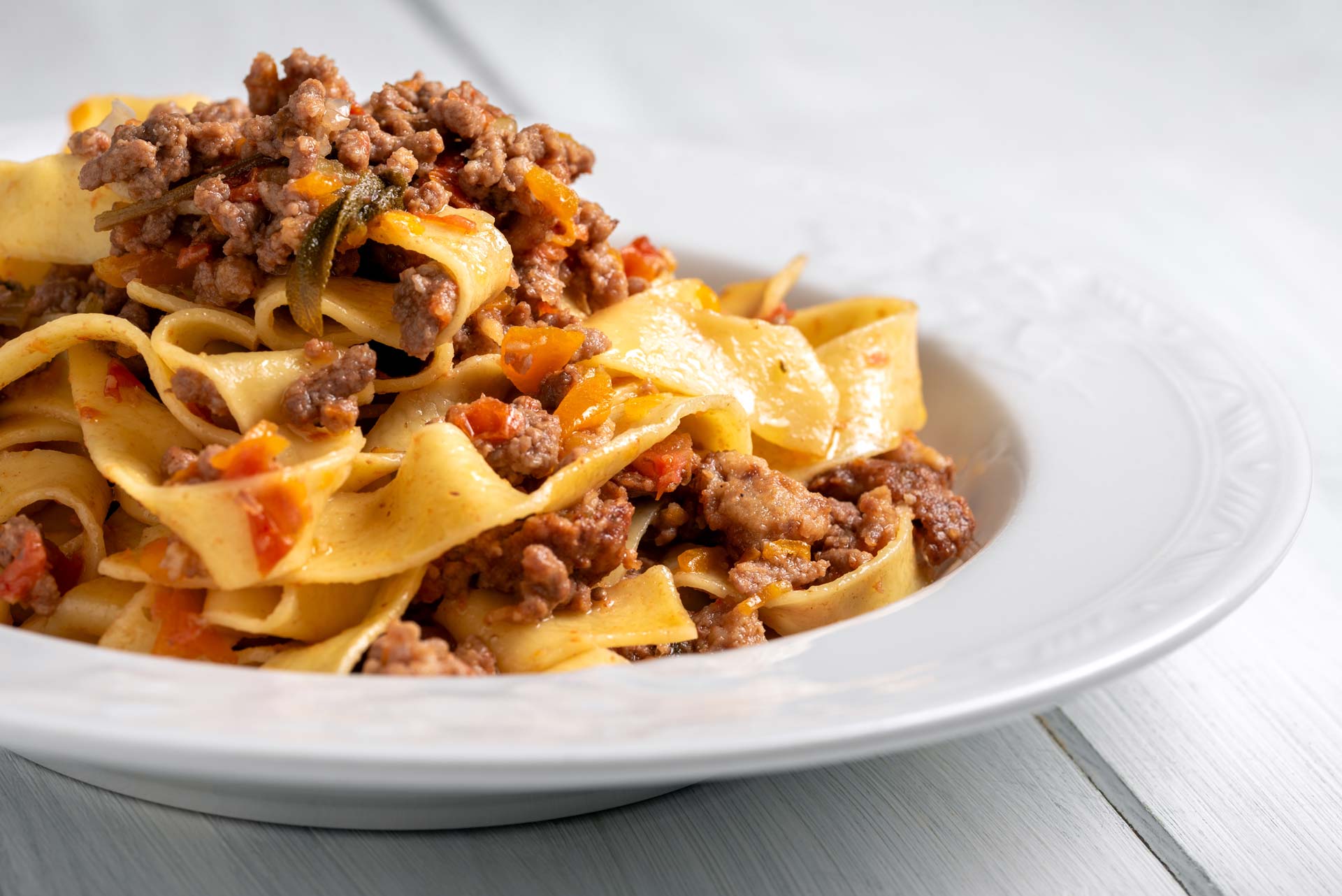
A symbol of Bolognese cuisine, tagliatelle with ragù is the most convivial and hearty version of a Sunday lunch.
Green lasagne
Layers of egg pasta, béchamel sauce and ragù: a dish that requires time and dedication, perfect for family occasions.
Every family has its own variation, treasured as a little piece of family heritage.
Main courses: roasts, boiled meats and country fare
After a substantial first course, the second course is never a light affair.
Among the most common dishes are:
• Assorted boiled meats with traditional sauces
• Roast veal or pork
• Oven-baked rabbit in the hilly regions
• Free-range chicken in rural areas
These dishes reflect the peasant origins of Emilian cuisine, where nothing was wasted and every ingredient had a specific role.
Wine with a meal: Lambrusco and Sangiovese
Sunday lunch is also the time to open a good bottle of wine.
In Emilia, Lambrusco complements cured meats, pasta and roasts with its freshness.
In Romagna, on the other hand, Sangiovese takes centre stage; it is more full-bodied and perfect for hearty dishes.
Wine is not a secondary element, but an integral part of the meal’s balance.
Dessert and coffee: a convivial way to round off the meal
No Sunday lunch is complete without dessert.
Zuppa inglese, homemade tarts, ciambella romagnola or torta tenerina are among the most common choices. Often prepared the day before, they symbolise the family-oriented nature of home cooking.
Then comes the coffee, perhaps accompanied by a homemade liqueur. And the table remains set for quite some time, because Sunday lunch is never rushed.
More than just a meal: a moment of identity
The culture of Sunday lunch in Emilia-Romagna goes beyond food. It is a time for:
• Family gatherings
• Intergenerational bonding
• Passing on recipes
• Slowing down the pace of the week
Even those who live far away often associate the idea of ‘home’ with this very ritual.
Today: between tradition and change
The pace of modern life has changed some habits, but Sunday lunch remains a fixture. Sometimes it takes place in a restaurant, perhaps a village trattoria; at other times, the menu is kept simple.
But the idea of taking time to sit down to a meal, of preparing something special compared to weekdays, continues to be part of Emilian culture.
Sunday lunch as a symbol of the Food Valley
The Food Valley is renowned worldwide for its culinary excellence, but it is around the Sunday dinner table that one truly understands its soul.
It is not just PDO products or Michelin-starred restaurants that tell the story of the region. It is the everyday scene of a family gathered round a plate of tortellini, the ragù simmering slowly, and the wine poured generously.
Sunday lunch in Emilia-Romagna is not a special occasion. It is an everyday tradition that continues, quietly, to define the identity of an entire region.