


Why Was the Ceramic District Established in Sassuolo?
Sassuolo is known worldwide as one of the leading centres of the Italian ceramic industry. Throughout the 20th century, this area successfully transformed its manufacturing tradition into a world-class industrial system, becoming the heart of Emilia-Romagna’s Ceramic Valley.
But why did the ceramic district develop in Sassuolo rather than in another town? The answer lies in a combination of geographical advantages, the availability of raw materials, entrepreneurial expertise, and technological innovation. Together, these factors encouraged the emergence and growth of an industry that is now internationally recognised.
The Origins of Ceramics in Sassuolo: A Centuries-Old Tradition
The history of ceramic production in Sassuolo dates back long before the industrial boom of the 20th century. As early as the 18th century, the area was home to ceramic manufacturing activities, supported by the presence of clay deposits and other resources needed for production.
An important milestone dates back to 1741, the year traditionally associated with the establishment of ceramic manufacturing in Sassuolo, which would eventually develop into a long-standing production tradition. Over time, craftsmanship and technical expertise became increasingly refined, laying the foundations for the industrial transformations that followed.
These early activities helped develop specialised skills in processing and firing ceramic materials, making Sassuolo a favourable environment for the growth of new ceramic businesses.
Clay and Geographical Location: Why Sassuolo Was the Ideal Place
One of the key factors behind the emergence of the Sassuolo ceramic district was the availability of natural resources suitable for production. The hills and foothills of the Modena area provided clay deposits that were particularly important during the early stages of ceramic manufacturing.
Geographical location also played a significant role. Sassuolo lies at the foot of the Apennines, in a strategic area between Modena and Reggio Emilia, close to populated centres, trade routes, and communities with established craft traditions.
As industrialisation progressed, the local availability of raw materials was no longer the only determining factor. The industry began sourcing materials from other areas as well, while infrastructure, technical expertise, and organisational capabilities became increasingly important.
The Economic Boom and the Birth of the Modern Ceramic District
The decisive transformation took place after the Second World War, particularly during the 1950s and 1960s. Post-war reconstruction and Italy’s economic boom led to a sharp increase in demand for building materials, including ceramic floor and wall tiles.
Sassuolo was well positioned to seize this opportunity thanks to its established manufacturing tradition and the emergence of numerous specialised companies. Industrial expansion quickly spread to neighbouring towns, including Fiorano Modenese, Formigine, Maranello and, in the Reggio Emilia area, Scandiano and Casalgrande.
Within just a few decades, production that had initially been concentrated in individual factories evolved into a fully developed ceramic industrial district, characterised by companies capable of collaborating, competing, and developing innovative manufacturing solutions.
Businesses and Innovation: The Secret Behind Ceramic Valley’s Success
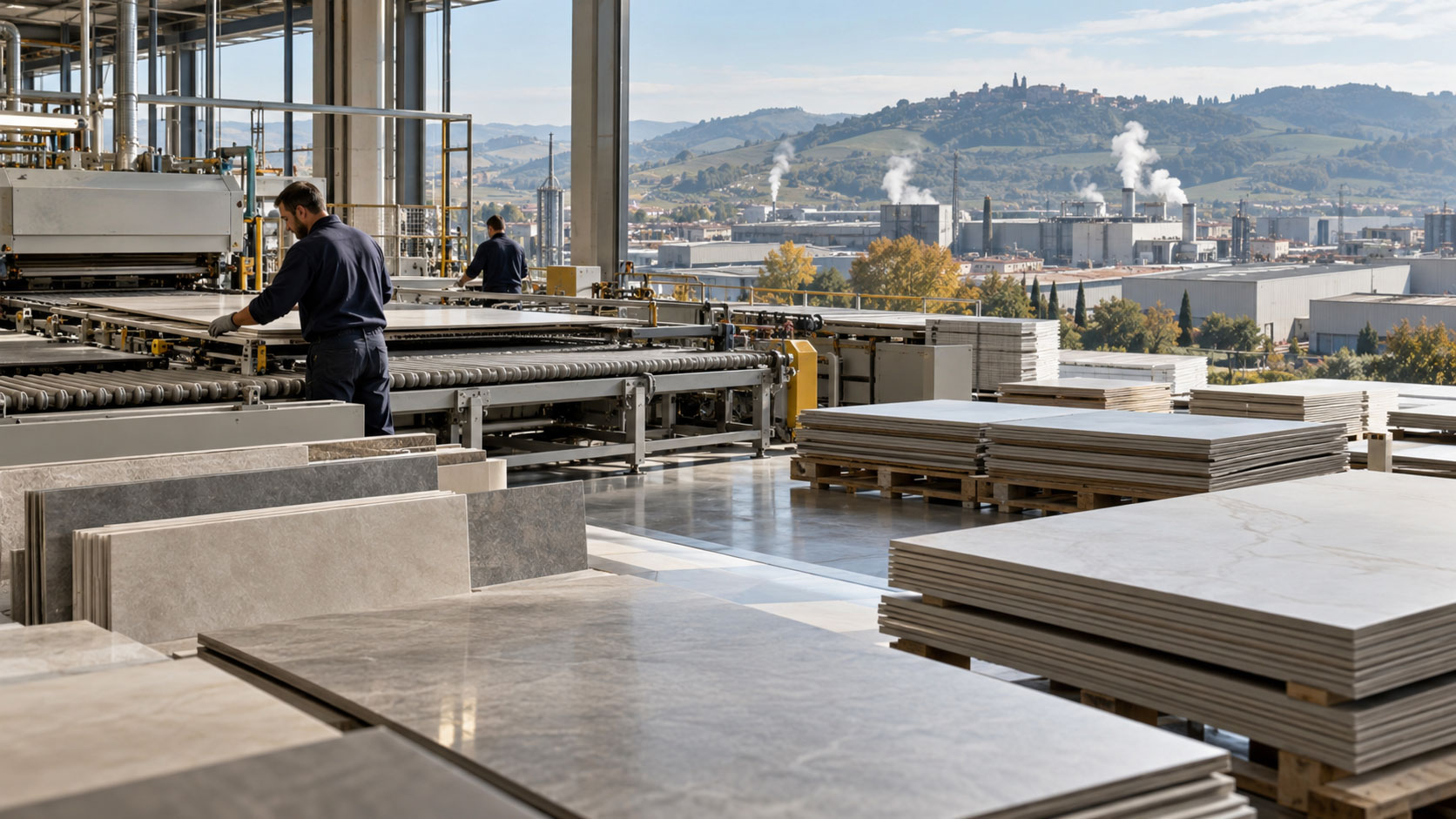
The success of the Sassuolo ceramic district was not simply the result of tile production, but also of the development of a highly specialised industrial ecosystem. Alongside ceramic manufacturers, companies specialising in machinery, glazes, decoration, technical services, and material-processing technologies began to flourish.
This concentration of expertise encouraged the continuous exchange of knowledge and accelerated innovation. Businesses were able to improve production processes, enhance product quality, and respond more quickly to market demands.
Over time, the district has contributed to the evolution of ceramic manufacturing techniques, from single-firing processes to modern porcelain stoneware surfaces, large-format ceramic slabs, and digital decoration technologies.
It is precisely this ability to innovate that has made Ceramic Valley an international benchmark not only for ceramic surfaces but also for the industrial technologies associated with their productio
Sassuolo Today: The International Heart of Italian Ceramics
Today, Sassuolo remains the symbolic centre of a manufacturing district stretching across the provinces of Modena and Reggio Emilia. This internationally oriented industrial system places increasing importance on quality, design, research, and sustainability.
Local companies invest in the development of innovative ceramic surfaces, energy efficiency, and the recovery and reuse of production materials, addressing the challenges of an industry that demands constant technological progress.
The concentration of specialised businesses, technical expertise, and an extensive supply chain continues to distinguish Sassuolo in the global ceramic industry, confirming the strength of an industrial model developed over generations.
Why Sassuolo Became the Capital of Ceramics
The emergence of the ceramic district in Sassuolo was no coincidence. It resulted from a combination of favourable conditions that strengthened over time. The initial availability of clay, geographical location, manufacturing traditions, and post-war economic growth created the foundations for extraordinary industrial development.
What transformed these opportunities into lasting success was, above all, entrepreneurial vision, business specialisation, and continuous technological research.
The history of the Sassuolo ceramic district demonstrates how an area can transform its resources and expertise into internationally recognised excellence, becoming one of the most important symbols of Made in Italy craftsmanship and Emilia-Romagna’s industrial identity.